

THE CASE / AT A GLANCE
From campaign investment to verified shelf execution.
Lam Soon’s KAPE programme applies ORCAS Promotion Execution to connect the authorised plan, each field visit and the decisions needed before a short selling window closes.
Meet Lam Soon.
Lam Soon is a Malaysian fast-moving consumer goods group with brands across food and household or personal-care categories, including cooking products, beverages and home-care ranges. Its products reach shoppers through retail and trade channels.
For a multi-category brand owner, the value of a promotion depends on what happens at the shelf during a limited campaign window. Outlet setup, availability, display evidence and rapid issue resolution connect trade investment to the shopper experience.
Explore Lam SoonWhat stood in the way?
A trade promotion is planned by chain, region, outlet and product, but its value depends on work completed at the shelf. Display setup, advertising material, stock, price and near-expiry checks can diverge across many visits. Separate plans, routes and photo trails make it hard to see whether an outlet was covered, whether the right SKU tasks were done, and who should resolve a refusal, stock gap or missed deadline.
Protect the selling window with accountable execution.
Give Trade Operations a way to authorise and dispatch the work, Key Account Managers a controlled way to tailor it by chain, and field representatives a clear brief for every outlet and SKU. Bring visit proof, stock exceptions and near-expiry cases back into one reviewable decision cycle.
- Outlet execution rate and display setup within the first three campaign days
- On-shelf availability and issue rate from SKU-level checks
- Unplanned visits, on-time GPS check-ins, no-shows and route consolidation
- Evidence completeness, approval or rejection, and time to close near-expiry cases
One authority chain from plan to proof.
Tech Creatures shaped ORCAS Promotion Execution for Lam Soon under the internal name KAPE. In the Admin Portal, Trade Operations sets a Master Bulletin: participating chains, business areas, allowed task types and regional notice. Activities are generated for each chain and business unit. A Key Account Manager then narrows the inherited scope, defines displays, products, targeting, schedule, forecast and commercial inputs, and submits the activity for an attributable approval. The approved plan feeds route planning across promotion work and a separate monthly Routine Stock Audit cycle.
The Field App gives each merchandiser a sequenced route and pre-visit brief. At the outlet, geofenced check-in starts SKU-specific display, advert, stock, price and near-expiry tasks, with required photos, reason codes and customer sign-off. Offline work queues for sync. A near-expiry finding opens a distinct Zerolisation case; management assigns an action and the same rep rechecks it on later visits until cleared. Portal dashboards distinguish a visit from proven execution and show where Trade Operations or a Key Account Manager must intervene.
- Authorise and approve scope
- Consolidate demand and dispatch routes
- Execute per SKU with evidence
- Review, decide and recheck
One plan. Every outlet. A visible next action.
The Admin Portal connects the back-office decision makers to the Field App used at the shelf. Campaign scope, routes, execution proof and issues move through one KAPE workflow.
Every outlet.
Visible execution.
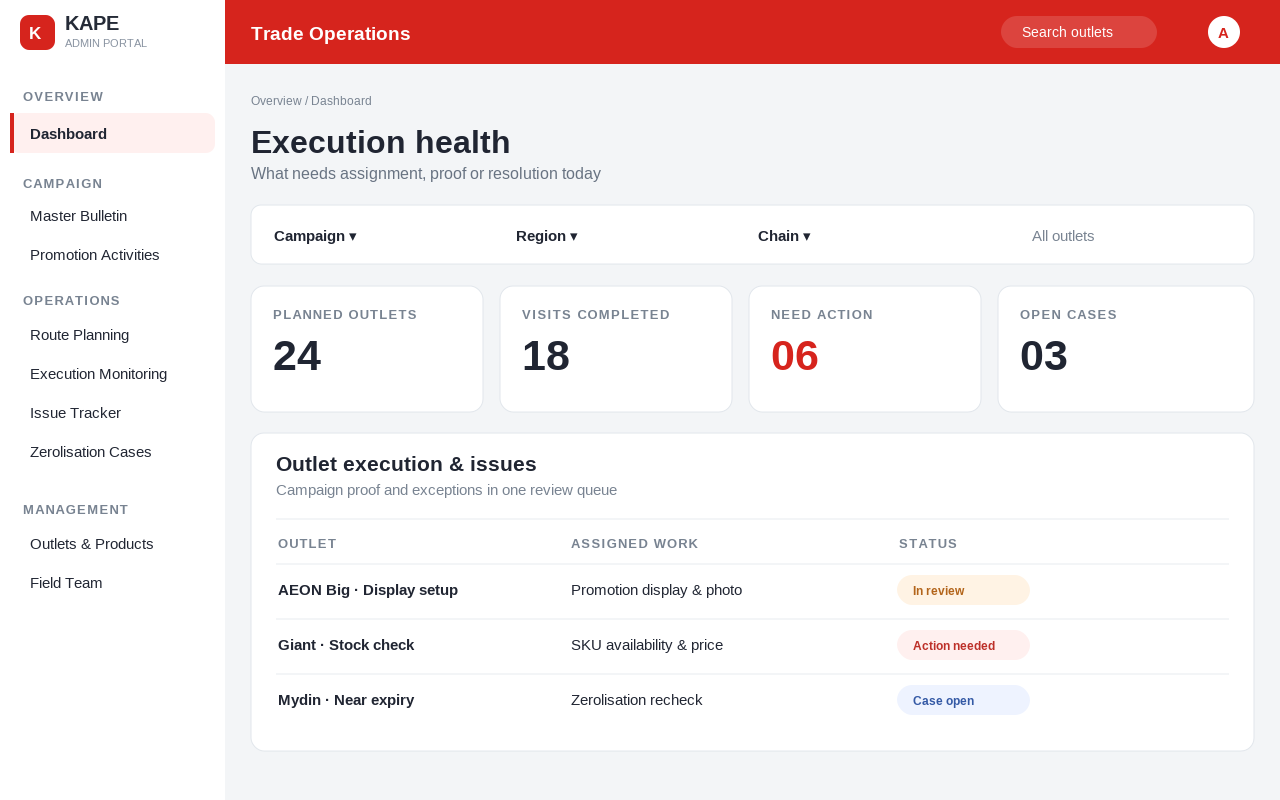
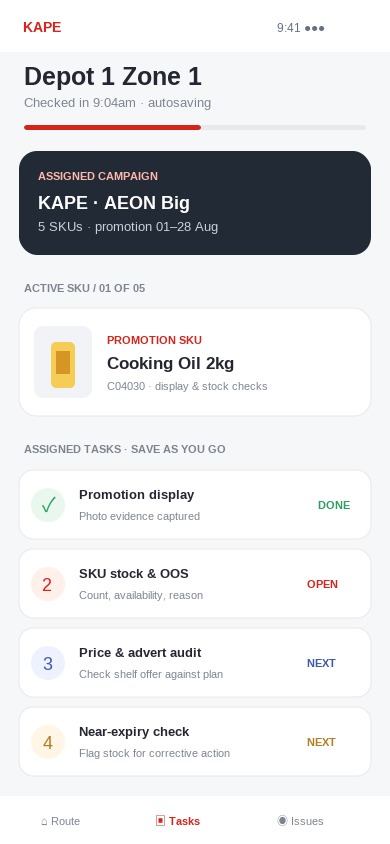
- Outlet check-in
- Promotion display & advert
- SKU stock & price checks
- Near-expiry inspection
- Routine Stock Audit
- Zerolisation recheck
The Admin Portal and Field App previews are adapted from the supplied KAPE interfaces for this showcase.
Keep every promotion ready to sell.
KAPE is designed to turn a chain-wide campaign plan into outlet-level action, with field evidence reaching the people who can protect the remaining selling window.
Track each planned display and advert by outlet and SKU. A missed setup or rejected placement becomes an immediate issue for the account and operations teams to salvage.
Merchandisers check availability, pack variants, price, display quality and near-expiry stock, with evidence and reasons that make the shelf condition reviewable.
Geotagged visits bring local market conditions into one view across regions and retailers. Connected submissions surface quickly; offline work queues until it can sync.
Issue ownership, corrective action and rechecks help recover selling days, reduce avoidable gaps and keep relevant promotional products available to shoppers.
These are the intended operating effects of the solution. Revenue, availability, quality and campaign return should be assessed against agreed field and sales measures.
Better field decisions reach the shelf and the shopper.
One execution record connects the work of Lam Soon, the retailer and the person buying the product.
Trade Operations
See coverage, missed setups, stock findings and unresolved issues across the retail footprint; redirect effort while a promotion is live.
Key Account Manager
Validate the chain-specific plan, intervene when access, display or commercial conditions block execution, and protect the account’s selling opportunity.
Field merchandiser
Follow a sequenced brief, verify each assigned SKU and shelf condition, record proof and raise an issue from the outlet.
Retail partner
Receive more consistent promotion setup, product availability and shelf follow-up, with issues made visible to the right Lam Soon owner.
Shopper
Find the intended offer and suitable product on shelf more reliably, with stock gaps and near-expiry concerns identified for action before they undermine the experience.
Design for the way trade work actually moves.
TC translated Lam Soon’s promotion authority, account planning, field activity and review into a connected model of ORCAS Promotion Execution. KAPE remains Lam Soon’s internal system name. The design keeps Routine Stock Audit as a distinct monthly workflow and Zerolisation as an event-triggered case, while sharing outlet, product, route and evidence context.
Policy & commercial logic
Master scope, per-chain overrides, approval, targeting, schedules, forecasts and derived campaign costs.
Dispatch & mobile work
Combine outlet demand, respect approved leave and deliver a route, brief and required per-SKU tasks.
Evidence & intervention
Record location and photo proof, explicit negative outcomes, offline sync and case rechecks for review.
Prove the loop in real outlets.
Review the working screens with Trade Ops, account managers and merchandisers to test a complete campaign: authorisation, approval, route, visit, evidence, decision and recheck. Confirm the open operating rules, including geofence radius and dwell time, stock thresholds, near-expiry evidence, leave upload, device support and photo quality.
Replace sample product and planogram assets, agree which deferred functions belong in the first release, then measure execution within the three-day window, on-shelf availability, issue resolution and route efficiency against an agreed baseline.